AI is changing how people check their skin. A phone camera can now assess visible concerns such as spots and uneven tone within minutes. But an automated scan and a medical examination are not the same thing. AI Skin Analysis vs. Dermatologist is really a question of what each method can assess, how much context it uses, and when professional care is needed. A 2026 study published in JAMA Dermatology found that skin conditions affect an estimated 2 billion people globally, while only about 28% of reported skin conditions are evaluated by dermatologists.
What Is AI Skin Analysis?
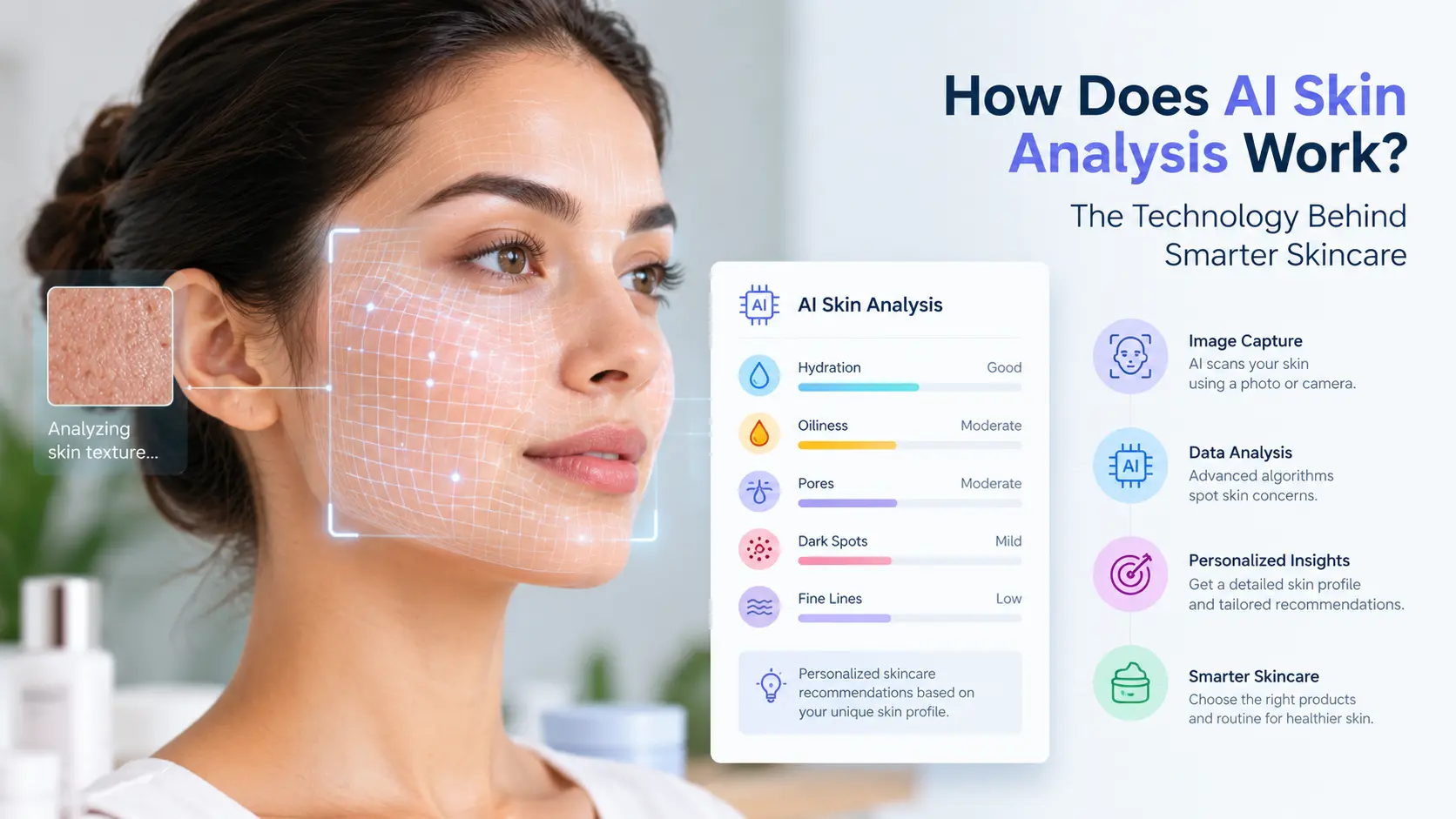
AI skin analysis uses software to assess an image of your skin. You usually take a photo or selfie. The system then looks for visible patterns linked to selected skin concerns.
For example, an AI tool may assess:
- Fine lines
- Pigmentation
- Redness
- Acne-related changes
- Uneven skin tone
- Visible pores
- Skin texture
- Other surface-level signs
The exact features depend on the software. Some systems give a score or estimate. Others provide information about possible concerns and suggest skincare steps.
For example, PERS ACTIVE LAB states that its system uses a selfie, AI, and image-based technology to assess skin concerns and provide a skin score with skincare recommendations.
This type of analysis is useful because it is quick and repeatable. You can also take images under similar conditions and compare changes over time.
However, an image has limits. It does not give the software the full medical history, physical examination, or clinical reasoning that a dermatologist can use.
What Happens During a Dermatologist Visit?
A dermatologist assesses your skin as part of a wider medical evaluation. The doctor can ask about your symptoms, how long they have been present, previous treatments, medicines, allergies, family history, and other relevant factors.
The examination may also involve looking closely at the affected area. Depending on the concern, a dermatologist may use tools such as dermoscopy or recommend further testing.
This matters because several skin conditions can look similar in a photograph. A doctor can consider the pattern, location, symptoms, progression, and other clinical information before deciding what to do next.
That makes a traditional Skin Consultation different from an automated image assessment. The consultation is based on the person as well as the visible skin changes.
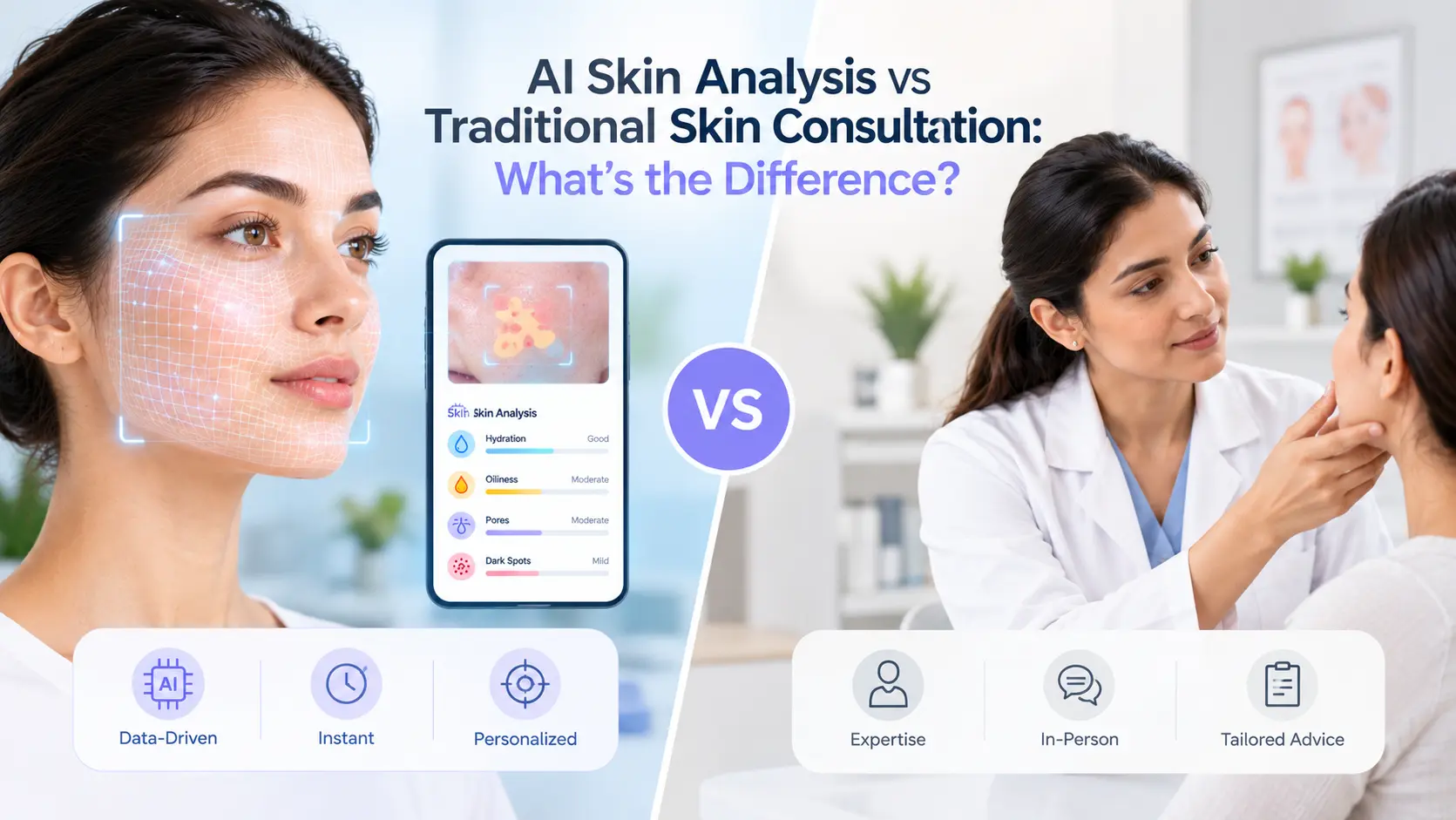
AI Skin Analysis vs Dermatologist: Key Differences
|
Factor
|
AI skin analysis
|
Dermatologist
|
|
Main input
|
Usually photographs
|
History, examination and photographs
|
|
Speed
|
Usually very fast
|
Takes longer
|
|
Availability
|
Can be available remotely
|
Requires access to a clinician
|
|
Repeated tracking
|
Easy to repeat
|
Usually done during follow-up visits
|
|
Medical history
|
Limited or user-entered
|
Discussed directly
|
|
Physical examination
|
No
|
Yes
|
|
Diagnosis
|
Depends on the tool and its intended use
|
Clinical diagnosis
|
|
Further testing
|
Cannot perform tests itself
|
Can recommend or arrange testing
|
|
Treatment decisions
|
May provide general suggestions
|
Can diagnose and prescribe treatment where appropriate
|
|
Serious or unusual concerns
|
Should not replace medical assessment
|
Appropriate route for medical evaluation
|
The table shows why these approaches should not be treated as interchangeable.
How Accurate Is AI for Skin Concerns?
The answer depends heavily on the task, dataset, and type of AI system. Research has shown that AI can perform well in controlled image-based studies. A 2024 systematic review and meta-analysis found that AI algorithms had a sensitivity of 87.0% and specificity of 77.1% across the included skin cancer studies. When compared specifically with expert dermatologists, AI performance was clinically comparable in that analysis.
A newer 2025 systematic review and meta-analysis also found strong overall performance across more than 70,000 test images. However, performance was lower for darker skin tones and in smartphone settings than in specialist settings.
This is an important point. A high research accuracy figure does not mean every consumer app will correctly identify every skin problem.
The American Academy of Dermatology warns that some apps designed to identify skin disease or skin cancer have shown poor accuracy. It recommends medical assessment rather than relying on an app for diagnosis.
Why Skin Tone and Image Quality Matter
AI systems learn from data. If the training data do not represent enough skin tones, conditions, or image types, performance may vary.
A 2024 review found that underrepresentation of skin of color remains a problem in dermatology AI. It reported that only 30% of the programs examined had reported data about their performance in skin of color.
A 2024 Nature Medicine study also found that physicians were less accurate when assessing images of dark skin compared with light skin. The study involved hundreds of physicians across 39 countries. It also found that decision support from a deep-learning system could improve physician performance.
So image quality and representation matter for humans and machines. Poor lighting, camera quality, shadows, and incomplete images can also affect an automated assessment.
Where AI Can Help
AI can be useful when its role is clearly defined.
It can help you:
- Track visible changes: Repeated images can help you compare skin appearance over time.
- Understand common concerns: A well-designed tool can give you information about visible features.
- Prepare for a doctor visit: Your observations and previous images may give you useful information to discuss.
- Support access: Digital tools can provide basic information when a dermatologist is not immediately available.
Recent research supports this limited but useful role. A 2026 JAMA Dermatology study found that an AI-powered informational tool was associated with better consumer understanding of skin concerns. The researchers also noted that results depended on the accuracy of the conditions presented.
PERS ACTIVE LAB can be considered in this broader context of consumer-focused skin assessment tools: the useful question is not whether technology replaces doctors, but where automated assessment can provide helpful information without creating false confidence.
When You Should See a Dermatologist
Do not rely on an AI scan when you have a new, changing, painful, bleeding or unusual skin lesion.
You should also seek medical care when:
- A rash keeps spreading or does not improve.
- A mole changes in size, shape or colour.
- A wound does not heal.
- You have severe or persistent acne.
- A skin problem affects your daily life.
- You are unsure what a new skin change means.
- A previous skin condition suddenly changes.
The FDA also distinguishes between AI medical devices designed to support clinicians and consumer software. For example, its current classification for certain AI-enabled skin-lesion devices describes them as physician-use adjunctive tools, not standalone diagnostic systems.
How to Use AI Responsibly
The safest approach is to treat AI as an information and tracking aid when the tool is intended for that purpose.
Check:
- What the tool actually claims to assess.
- Whether its accuracy has been tested.
- Which skin tones were included in testing.
- Whether the company explains how images and personal data are handled.
- Whether the tool is intended for medical diagnosis or general skincare information.
PERS ACTIVE LAB follows the same basic principle worth applying to any digital skin tool: understand what the technology can assess before treating its result as a medical conclusion.
AI Dermatology research is moving quickly, and the evidence is becoming stronger. WHO is also studying AI-based tools for skin conditions, while stressing the need for sound technical development, suitable image databases, and expert input.
Conclusion
AI can make skin assessment faster and easier. It can help you track visible changes and understand common concerns. But it cannot provide the complete clinical assessment that a dermatologist can provide.
The best choice depends on your purpose. For routine tracking or general information, an appropriate AI tool may be useful. For diagnosis, persistent symptoms, suspicious lesions, or treatment decisions, professional medical care remains the safer option.
PERS ACTIVE LAB can fit into the wider conversation about responsible digital skin assessment, where technology supports informed decisions without replacing clinical judgment.
FAQs
1. Is AI skin analysis as accurate as a dermatologist?
Not in every situation. Research shows that some AI systems can perform at a level comparable to dermatologists for specific image-based tasks. Results vary by condition, image quality, skin tone, and testing method. AI should not automatically be treated as a medical diagnosis.
2. Can AI detect skin cancer?
Some AI systems have been developed to assess skin-cancer risk or assist clinicians. However, consumer apps vary greatly in accuracy. The American Academy of Dermatology recommends seeing a dermatologist rather than relying on an app to diagnose skin cancer.
3. Can AI skin analysis work on darker skin tones?
It can, but research shows that performance may be lower for darker skin tones in some systems. Better representation in training data and testing across different skin tones are important for reliable performance.
4. Should I use AI before a dermatologist appointment?
You can use an appropriate tool for general information or to track visible changes, but do not use its results to rule out a medical condition. Share relevant changes or images with your dermatologist when you attend your appointment.




 Successfully Added!