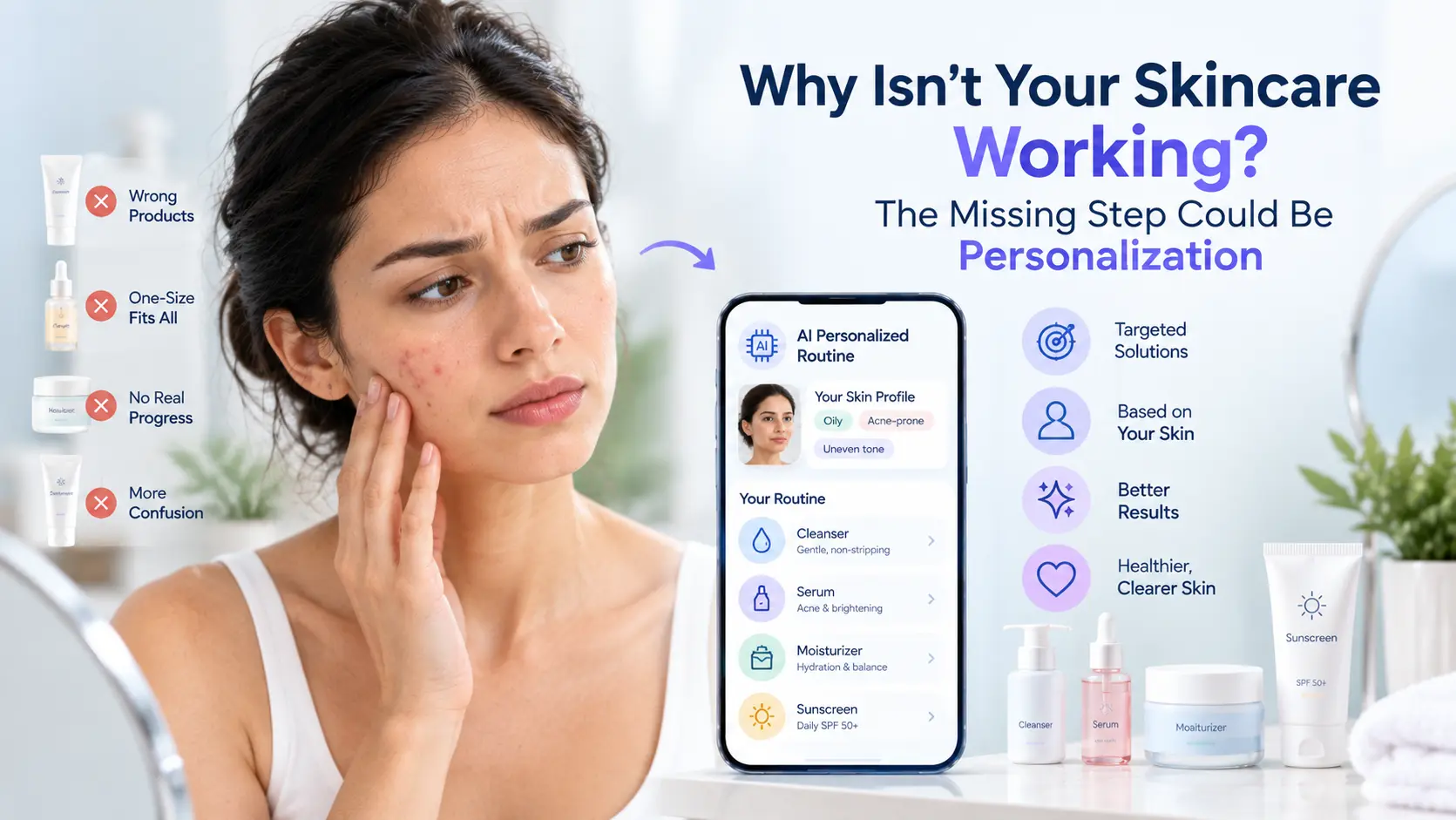
You can use good skincare products and still see little change. The reason may be simple: your products do not match your skin. Your skin type, and daily habits all affect what you need and a routine made for oily, acne-prone skin may be too drying for someone with sensitive skin. A rich cream may feel helpful on dry skin but heavy on oily skin. This is why a Personalized Skincare Routine can make more sense than copying a routine from social media.
A 2026 AI-led study of 21,373 adults across 725 Indian cities reported that 79% of participants had at least one moderate skin concern, while the average person had three concerns at the same time. In this article, we will talk about why a routine may not be working for you, how personalization can help, and what to consider when building a skincare routine that fits your skin.
Why A Standard Routine May Not Work For You
There is no single routine that suits everyone. The American Academy of Dermatology (AAD) says skincare products should match your skin's needs and type. It identifies common skin types as normal, dry, oily, combination, and sensitive.
Your main concern matters too.
For example:
- Oily skin may need products that help control excess oil without stripping the skin.
- Dry skin often needs more moisture and gentle cleansing.
- Sensitive skin may react to fragrance or other ingredients.
- Acne-prone skin may benefit from non-comedogenic products.
- Pigmentation needs a different approach from simple dryness.
- Aging concerns may call for targeted ingredients rather than several random products.
This is where a Customized Skincare Routine can be useful. Instead of starting with popular products, you start with your actual skin needs. The goal is not to use more products. It is to choose the right products and use them consistently.
Personalization Starts With Your Skin, Not The Product
A useful Skin Care Routine starts with a simple assessment. Look at how your skin behaves after cleansing. Does it feel tight? Does it become shiny quickly? Are some areas oily while others feel dry? Does your skin sting after applying products?
IADVL recommends identifying your skin type before buying a skincare range. It also notes that cleansing, moisturizing, and protection are the basic steps. Other products, such as exfoliants and serums, depend on your skin concerns.
Your routine should also consider factors such as:
- Skin type — oily, dry, combination, normal, or sensitive.
- Main concern — acne, dryness, pigmentation, redness, texture, or fine lines.
- Current products — using several strong products can increase irritation.
- Environment — heat, humidity, pollution, and sun exposure can affect your skin.
- Tolerance — an ingredient that works well for one person may irritate another.
This is why copying someone else's routine can fail even when the products are popular.
What A Personalized Routine Should Actually Include
Personalization does not mean creating a 10-step routine. The AAD recommends a simple base: cleansing, moisturizing, and sun protection. It also advises limiting unnecessary products because too many products can cost more and may irritate the skin. A simple framework looks like this:
|
Skin need
|
What to focus on
|
|
Dry or tight skin
|
Gentle cleansing and regular moisturization
|
|
Oily skin
|
Gentle cleansing and non-comedogenic products
|
|
Sensitive skin
|
Fewer products and careful ingredient selection
|
|
Acne-prone skin
|
Non-comedogenic products and targeted acne care
|
|
Pigmentation
|
Sun protection and a suitable targeted ingredient
|
|
General skin health
|
Cleanse, moisturize, and protect from UV
|
The table is a starting point, not a diagnosis. Persistent acne, or sudden skin changes need professional assessment.
The Order Matters, Too
Even good products may not help if you use them poorly. For a basic morning routine, you can usually think in this order:
Cleanser → treatment product, if needed → moisturizer → sunscreen
At night:
Cleanser → treatment product, if needed → moisturizer
The AAD recommends washing with a gentle, non-abrasive cleanser and limiting facial cleansing to twice a day and after heavy sweating.
Sunscreen is especially important. The AAD recommends broad-spectrum SPF 30 or higher for daily sun protection. The exact treatment step depends on your concern. You do not need an exfoliating acid, or several active ingredients simply because they are popular.
Why Using Too Many Actives Can Backfire
More active ingredients do not automatically mean better results. For example, someone with oily skin may assume that stronger cleansing will help. But the AAD notes that harsh cleansing can irritate oily skin and may even trigger increased oil production and also, recommends gentle cleansing and continued moisturization for oily skin.
Sensitive skin needs even more care. Cosmetic products can cause allergic reactions or contact dermatitis in some people. The FDA advises reading ingredient labels and avoiding ingredients known to cause reactions.
A Customized Skincare Routine should therefore consider what your skin can tolerate, not only what you want to treat.
Personalization can also mean using less
Personalization is sometimes misunderstood as having a product for every concern. It can mean the opposite.
Cleveland Clinic notes that a skincare routine should be tailored to your skin type and goals. That could mean using three reliable products instead of eight products that overlap.
The same principle appears in the approach described by PERS ACTIVE LAB. Its Skin Beauty PAL system uses selfie-based skin analysis to assess visible concerns and provide personalized recommendations. The company's website says its approach focuses on essential active ingredients and lists concerns such as acne, and enlarged pores. These are company claims, so they should not be treated as independent clinical proof. The useful idea here is the process: assess your skin, and then track how your skin responds.
How To Build A Better Routine
Start small.
1. Identify your main problem
Do not try to treat everything at once. Pick your biggest concern first.
2. Check your skin type
Notice how your skin feels and behaves without relying only on labels.
3. Keep the basics stable
Use a gentle cleanser, moisturizer, and sunscreen that suit your skin.
4. Add one targeted product
Give your skin time to adjust. Adding several new products at once makes it difficult to know what is helping or causing irritation.
5. Watch your skin
Look for changes in dryness, oiliness, redness, breakouts, and comfort.
6. Change the routine when your skin changes
Your skin does not stay exactly the same. Weather, age, hormones, medication, and other factors can affect it. This is the real value of a Customized Skincare Routine. It can change when your needs change.
When You Should See A Dermatologist
Personalization has limits. An app, or product recommendation cannot replace a medical diagnosis. A dermatologist can assess conditions that may look like ordinary acne, or pigmentation.
Seek professional advice when you have:
- Painful or severe acne
- Persistent rashes
- Swelling or intense itching
- Burning that does not settle
- Sudden changes in your skin
- Pigmented spots that change, or become painful
The FDA also advises medical attention for serious allergic reactions.
Conclusion
When skincare is not working, the answer may not be another product. Your routine may simply be poorly matched to your skin. A good approach starts with your skin type, and daily needs. Keep the basics simple. Add targeted products only when they have a clear purpose. Watch how your skin responds and adjust when needed.
That is the practical value of personalization. PERS ACTIVE LAB is using skin analysis and targeted formulations as one way to support this approach, but the same principle applies even when you build your routine yourself: choose based on your skin, not the trend.
FAQs
1. Is a Personalized Skincare Routine better than a normal routine?
Not automatically. A Personalized Skincare Routine can be more suitable when it accounts for your skin type, and lifestyle. A simple routine can work very well when the products already match your needs.
2. How often should I change my Skin Care Routine?
Do not change it every few days. Give a new product enough time to assess how your skin responds, unless you develop irritation. Change your Skin Care Routine when your skin needs change or when a product clearly does not suit you.
3. Can AI create a Customized Skincare Routine?
AI can help organize visible skin information and suggest products or routines. Skin-Pal, for example, says its AI system uses selfie-based analysis to identify visible concerns and provide recommendations. However, image-based tools have limits. They should not be treated as a medical diagnosis.
4. What is the most important step in a Skin Care Routine?
There is no single product that matters for everyone. The basics are cleansing, moisturizing, and sun protection. The right products depend on your skin type and concerns.






 Successfully Added!