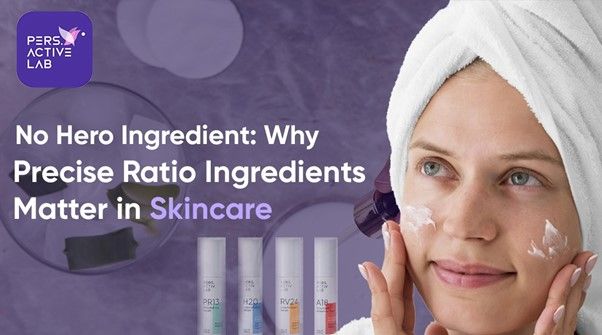
Whenever you walk into a beauty store, you’ll see the same thing again and again. Large labels that read "Vitamin C serum," "Retinol cream," and "Peptide booster." One ingredient gets all the attention. It becomes the hero, selling point, and the star of the show. But real skincare does not work like that.
A product is never just one ingredient. It’s a system and a formula that is a careful mix of many parts working together. Change the ratios, and the product can fail quickly. Great skincare comes from balance, not hype.
In this blog, we discuss why no hero ingredient carries a formula, and why the exact ratios matter more than most people realise.
Skincare Is Chemistry First, Marketing Second
Every cream, gel, or serum starts in a lab. Chemists don’t begin with retinol; they start with structure.
They ask:
- How thick should this feel?
- Should it absorb fast?
- Should it stay over six months?
- To deliver the active ingredients safely?
Only then do they build the formula.
Skincare is at the intersection of chemistry, biology, and texture design. Some people call it part science and part art. The truth is that it’s almost entirely science, with a bit of creative thinking on top.
A great product works because everything inside supports everything else. Not because one ingredient looks good on the label.
The Myth of the “No Hero Ingredient”
Retinol gets the credit, vitamin C gets the spotlight, and peptides get the praise. But none of them work properly alone. Put pure retinol on your face without stabilisers or soothing agents, and you’ll irritate your skin fast. Use vitamin C without the right pH, and it won’t even function. Add peptides to a bad base, and they won’t penetrate at all.
The so-called hero depends on the rest of the formula to perform. So when someone says, “This product has 1 percent retinol, so it must be strong,” they’re missing the bigger picture.
Concentration matters; no hero ingredient alone carries a product.
Precise Ingredients Ratio : Active vs Functional Ingredients
You’ve probably seen ingredients described as “active” or “inactive.” In a good formula, every ingredient has a job. Still, the distinction helps when you read an INCI list.
Active Ingredients
These target specific skin concerns. They create measurable changes.
Common examples include:
- Retinoids like retinol or retinaldehyde
- Vitamin C derivatives
- Salicylic acid
- Niacinamide
- Peptides
- Azelaic acid
- Hyaluronic acid
They get most of the attention.
Functional Ingredients
These support the formula. They control texture, stability, and safety. Without them, the product would separate, spoil, or feel awful.
Examples include:
- Solvents like water or glycerin
- Emulsifiers
- Preservatives
- Thickeners
- pH adjusters
- Stabilizers
They’re functional, not inactive. Because without them, nothing works.
Why Ratios Matter More Than Ingredient Lists
Two products can share the same ingredients and feel completely different. It’s all because of ratios.
A small change in percentages can transform:
- Absorption speed
- Thickness
- Skin feel
- Irritation level
- Shelf life
- Effectiveness
For example, salt, flour, and water exist in many recipes. But bread and pancakes taste nothing alike. The difference lies in proportions.
Skincare works the same way. Too much thickener, and the serum feels sticky. Too little preservative and it spoils. If there’s too much acid, the skin can burn. With too little emulsifier, the formula can separate.
Formulation is all about these small numbers.
The Role of Rheology in Skin Feel
Here’s a term you don’t hear often outside labs: rheology. It means the study of how materials flow and deform.
In skincare, it controls how a product spreads and sits on the skin.
It decides whether a cream feels:
- Silky
- Heavy
- Greasy
- Watery
- Cushiony
Chemists adjust rheology using thickeners, gums, emulsifiers, and polymers. This step doesn’t just improve comfort. It also affects how active ingredients get delivered.
A product that spreads evenly performs better. A product that pills or drugs wastes ingredients. So texture is not just cosmetic. It’s functional science.
Debunking the “Chemical-Free” Claim
Let’s clear this up fast; nothing is chemical-free. Water, plant oils, and even air are made of chemicals.
Any brand using that phrase either misunderstands basic science or leans into fear marketing. Good skincare uses safe chemistry, and that’s it.
The truth is that what counts is the testing, not the source.
Multifunctional Ingredients Do Double Duty
Some ingredients serve as both helpers and skin improvers. These are often the quiet stars of a formula. Glycerin hydrates and also works as a solvent. Niacinamide supports stability and improves tone.
Precise ratio ingredients show why the active versus functional label can feel misleading. One ingredient can play several roles.
A Formula Works Like a Team
Think of a skincare product like a sports team. The active ingredients score the goals, and the functional ingredients defend, pass, and control the game.
Take away the support players, and the star striker can’t do anything. That’s how formulas behave, too. A good product feels balanced. It spreads well. It stays stable. It delivers results without irritation.
That balance only happens when the ratios are right.
How This Helps You Read Labels Smarter
When you scan an ingredient list, stop searching for just one buzzword.
Instead, ask:
- Does this formula include hydrants?
- Does it contain soothing agents?
- Are there stabilisers and preservatives?
- Does it look thoughtfully built?
A long ingredient list doesn’t mean filler. It often means structure. Simple formulas work sometimes. Complex ones work better for advanced goals. Context matters in all cases.
Conclusion
None of the components is effective in isolation. Retinol, for example, requires assistance; vitamin C must be in the proper setting, while peptides need to be delivered correctly. The secret lies in the proportions. This is where chemistry operates and produces the results. Choose brands that highlight their precise ratio of ingredients, quality, and balance.
If you want skincare that actually works, choose formulations built with science and care. Read beyond the headline ingredients with Skin-Pal. Browse through our skincare range, curated specifically for your skin!
FAQs
1. What is a hero ingredient in skincare?
It’s the main active highlight for marketing, like retinol or vitamin C. It does not carry the product alone.
2. Are inactive ingredients just fillers?
No. They control texture, safety, stability, and delivery. Without them, the formula fails.
3. Do higher percentages mean better results?
Not always. Too much can irritate the skin. Correct ratios matter more than high numbers.
4. Is natural skincare safer than synthetic?
Safety depends on testing and formulation, not source. Many synthetic ingredients are safer and more consistent.




 Successfully Added!