Your acne may be gone, but your skin can still feel uneven. Tiny dents and rough patches often remain because acne affects more than the skin's surface. During healing, inflammation can damage collagen and elastin, the proteins that keep your skin smooth and firm. If collagen production becomes unbalanced, the skin heals with an uneven surface instead of a flat one. This is why treating texture requires more than fading dark spots. The right uneven skin texture treatment supports skin repair, not just exfoliation.
According to a 2026 review based on Global Burden of Disease (GBD) 2021 data, acne affects about 3.04% of the global population. This highlights why post-acne skin concerns are in focus. This article will cover the causes and treatments for uneven skin texture after acne.
What Happens to Skin After Acne? (Quick Overview)
|
Skin Change
|
What Happens Inside the Skin
|
Visible Result
|
|
Collagen loss
|
Inflammation triggers collagen breakdown.
|
Depressed scars and uneven texture
|
|
Excess collagen
|
Fibroblasts produce too much collagen during healing
|
Raised or thick scars
|
|
Slower skin renewal
|
Dead skin cells remain on the surface longer
|
Dull, rough appearance
|
|
Enlarged pores
|
Surrounding collagen weakens after inflammation
|
Uneven-looking skin surface
|
|
Barrier damage
|
Water loss increases, and irritation becomes common
|
Dry, bumpy skin that feels rough
|
Top 5 Causes of Uneven Skin Texture After Acne
Acne scars do not appear for the same reason in every person. The type of breakout and even daily habits influence how your skin heals. Understanding the cause gives the right treatment.
1. Collagen Breakdown During Inflammation
Inflamed acne lesions release inflammatory chemicals such as interleukin-1 (IL-1), and matrix metalloproteinases (MMPs). These enzymes damage collagen before healing begins.
Here's what happens inside the skin:
- MMP enzymes break down healthy collagen fibers.
- Deep nodules and cysts cause greater collagen destruction.
- Less structural support leaves shallow or deep depressions.
- Skin repairs itself unevenly when collagen production cannot fully replace what was lost.
Once collagen architecture changes, the skin surface reflects those changes, and this is why depressed acne scars often remain visible after pigmentation. According to Pers. Active Lab, powered by the Skin Beauty Pal, early treatment is often more effective than treating older scars.
2. Picking Pimples
Mechanical trauma often causes more damage than the pimple itself. Pressing a lesion pushes bacteria and inflammatory material deeper into surrounding tissue, increasing the area of injury. Nearby healthy skin also becomes inflamed, delaying the healing process.
This extra injury can lead to:
- Rupture of the follicle wall beneath the skin.
- Deeper inflammation in the dermis.
- Increased risk of permanent scarring.
- Longer healing time compared with untouched acne lesions.
Many people notice rough skin after acne because repeated picking disrupts normal wound healing. Instead of creating one clean repair site, the skin must rebuild multiple damaged areas simultaneously.
3. Abnormal Collagen Production During Healing
After inflammation settles, fibroblast cells begin producing fresh collagen. Ideally, this new collagen should restore the skin's original structure. But sometimes, collagen production becomes unbalanced.
Rather than rebuilding evenly, the body either produces too little collagen or too much in one location.
This imbalance may result in:
- Ice-pick scars from significant collagen loss.
- Boxcar scars with sharply defined edges.
- Rolling scars caused by fibrous bands pulling the skin downward.
- Raised hypertrophic scars from excessive collagen deposition.
Different scar types respond to different forms of acne texture repair. For example, rolling scars often improve with subcision, and ice-pick scars respond better to procedures such as TCA CROSS.
4. Delayed Skin Cell Turnover
Healthy skin naturally sheds dead cells every 28-40 days in younger adults. After acne, inflammation can temporarily slow this renewal cycle. Dead cells build up, creating rough texture without scars. Oily skin often shows this more because excess sebum traps dead cells.
Some common effects include:
- Dead skin accumulating around follicle openings.
- Persistent clogged pores.
- Small bumps that resemble healed acne.
- Reduced light reflection, making texture appear worse.
Resurfacing skincare uses acids and retinoids instead of surface-level scrubs.
5. Damage to the Skin Barrier
Many people use multiple acne products together without allowing the skin barrier to recover. High-strength benzoyl peroxide and frequent cleansing can strip protective lipids from the outer skin layer.
A weakened barrier increases water loss. This makes the skin feel rough even when scars are minimal.
Common signs include:
- Tightness after washing.
- Flaking around healed acne.
- Increased sensitivity to skincare products.
- Small rough patches that persist throughout the day.
People often mistake this dryness for permanent scarring. Barrier repair can improve rough skin after acne caused by irritation.
Top 5 Solutions for Uneven Skin Texture After Acne
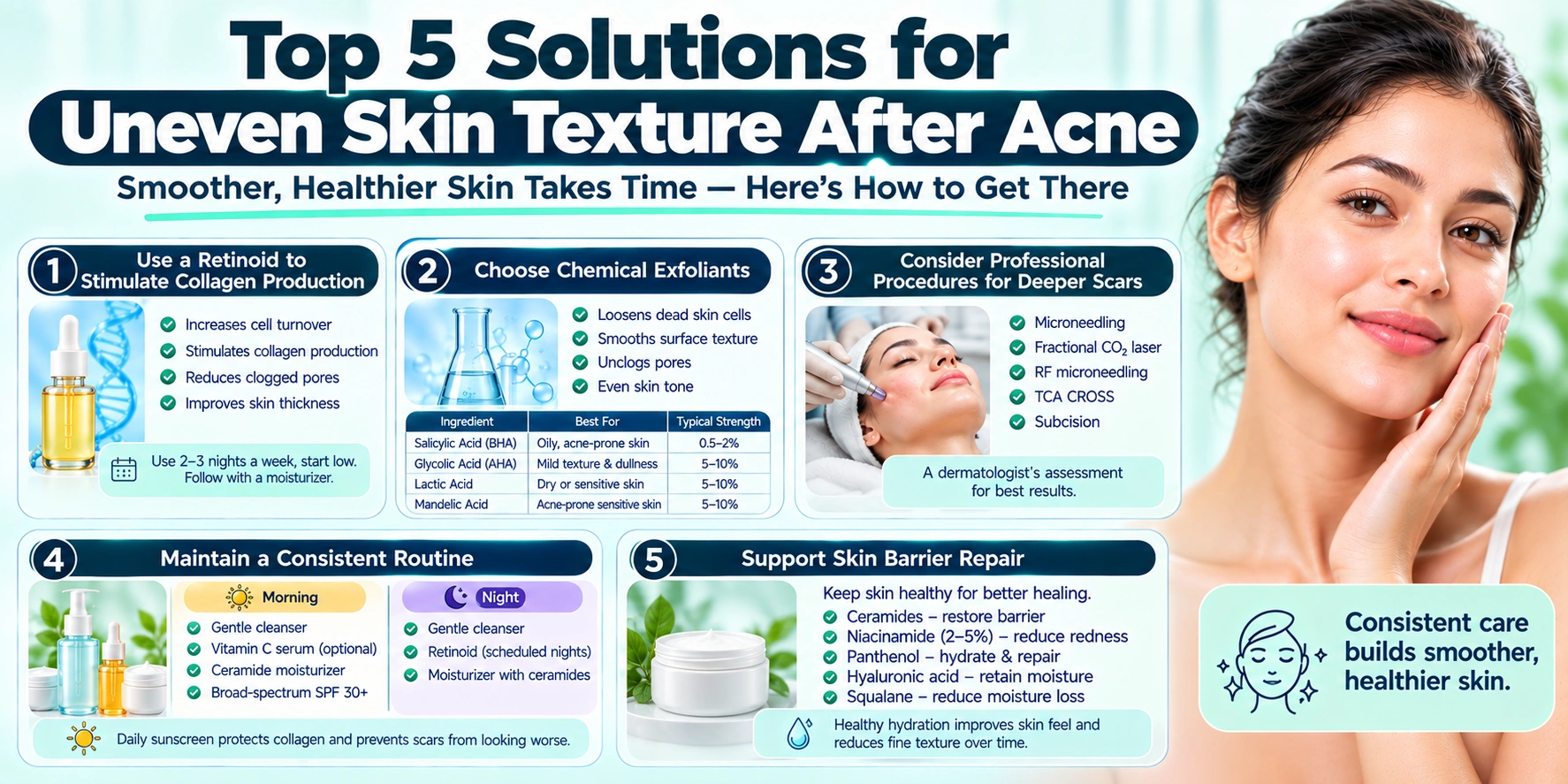
Improving skin texture takes time because collagen rebuilds slowly. Most treatments work by encouraging controlled skin renewal or stimulating new collagen production. But the right approach depends on whether your texture comes from true scars or barrier damage.
1. Use a Retinoid to Stimulate Collagen Production
Topical retinoids remain one of the most studied options for improving post-acne texture. They speed up cell turnover and encourage fibroblasts to produce healthier collagen. With consistent use, they make skin appear more even over several months.
Here's how retinoids improve texture:
- Increase epidermal cell turnover.
- Stimulate collagen types I and III production.
- Reduce clogged pores that make texture appear worse.
- Improve skin thickness over time.
Retinoids work gradually, so visible improvement usually appears after 12–24 weeks of consistent use. Start with a low concentration two or three nights each week to reduce irritation. Also, a moisturizer should always follow application to support the skin barrier.
2. Choose Chemical Exfoliants
Physical scrubs remove surface flakes. But they cannot repair damaged collagen. Chemical exfoliants work differently. They loosen the bonds between dead skin cells. This allows the skin to shed evenly without causing additional friction.
The best choice depends on your skin type. Salicylic acid works inside pores, while glycolic acid reaches deeper into the skin's surface layers.
The following ingredients are commonly recommended:
|
Ingredient
|
Best For
|
Typical Strength
|
|
Salicylic Acid (BHA)
|
Oily, acne-prone skin
|
0.5–2%
|
|
Glycolic Acid (AHA)
|
Mild texture and dullness
|
5–10%
|
|
Lactic Acid
|
Dry or sensitive skin
|
5–10%
|
|
Mandelic Acid
|
Acne-prone sensitive skin
|
5–10%
|
This type of resurfacing skincare helps smooth superficial irregularities. But it will not completely remove deeper scars because collagen remodeling occurs below the skin's surface.
3. Consider Professional Procedures for Deeper Scars
Some scars extend into the dermis, making topical products alone insufficient. Dermatologists often combine procedures because of different treatments.
Treatment selection depends on scar depth rather than the number of scars.
Common options include:
- Microneedling to boost collagen.
- Fractional CO₂ laser for deeper scars.
- RF microneedling with minimal downtime.
- TCA CROSS for narrow ice-pick scars.
- Subcision for rolling scars tethered beneath the skin.
Clinical studies show that combining treatments often produces better outcomes than a single procedure. Pers. Active Lab, powered by the Skin Beauty Pal, recommends a dermatologist's assessment for the best treatment results.
4. Maintain a Consistent Routine
Texture improves faster when your skin barrier stays healthy. Using too many active ingredients can delay recovery.
A simple routine allows the skin to repair itself while active ingredients work consistently.
A practical smooth skin routine includes:
Morning
- Gentle cleanser
- Vitamin C serum (optional)
- Ceramide-based moisturizer
- Broad-spectrum SPF 30 or higher
Night
- Gentle cleanser
- Retinoid on scheduled nights
- Moisturizer containing ceramides or glycerin
Daily sunscreen helps protect collagen and prevents scars from looking worse.
5. Support Skin Barrier Repair
Texture improvement is not only about stimulating collagen. Healthy skin needs moisture and barrier repair for better healing.
These ingredients work well alongside active treatments instead of replacing them.
Look for products containing:
- Ceramides to restore the protective barrier.
- Niacinamide (2–5%) to improve barrier function and reduce redness.
- Panthenol for hydration and skin repair.
- Hyaluronic acid to increase water retention.
- Squalane to reduce moisture loss.
Following a consistent smooth skin routine helps these ingredients support long-term skin recovery. Healthy hydration will not erase scars. But it can noticeably reduce the appearance of fine texture and improve overall skin feel.
Conclusion
Uneven skin texture after acne develops because inflammation changes the skin's collagen structure and healing process. The best uneven skin texture treatment depends on the underlying cause. Mild texture improves with retinoids, while deeper scars require procedures.
Daily sunscreen and a consistent routine help maintain smoother skin. Pers. Active Lab, powered by the Skin Beauty Pal, offers skincare solutions that support healthier skin and complement professional treatment plans when needed.
Frequently Asked Questions
1. Can uneven skin texture after acne heal naturally?
Mild texture caused by dryness or slow cell turnover may improve over time. However, scars caused by collagen loss usually need targeted uneven skin texture treatment such as retinoids, or laser procedures to achieve noticeable improvement.
2. How long does acne texture repair take?
Most topical treatments require at least 3–6 months of consistent use before visible changes appear. Professional treatments improve texture over multiple sessions.
3. Does vitamin C improve acne scars?
Vitamin C helps reduce post-inflammatory pigmentation and supports collagen production. It improves skin tone. But it cannot treat deep scars alone.
4. Is laser treatment better than microneedling for acne scars?
Neither treatment is universally better. Fractional lasers are more effective for deep boxcar scars. Microneedling suits a mild-to-moderate texture with less downtime.

 Member Center






 Successfully Added!